
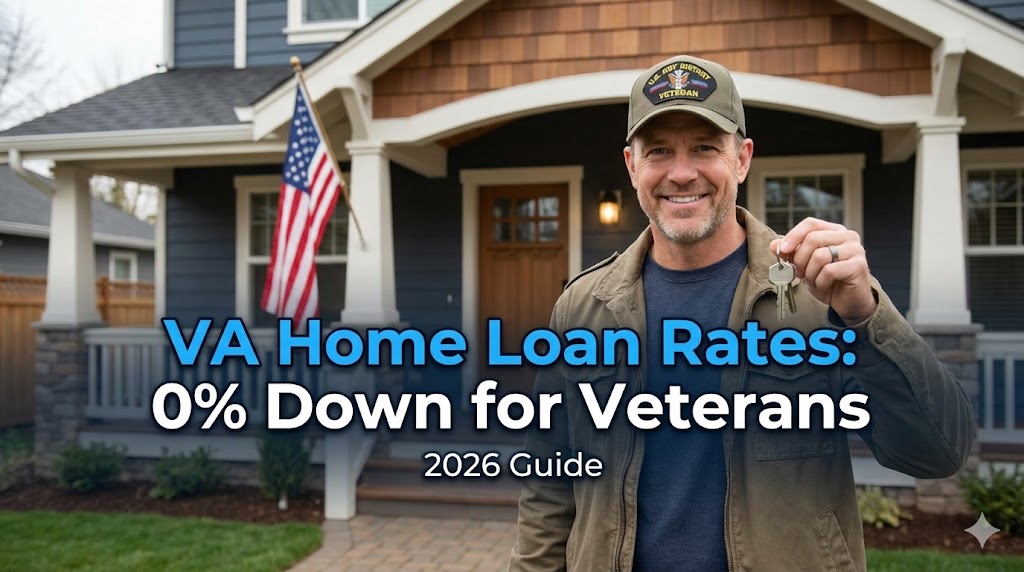
For the millions of brave men and women who have served in the United States military, the transition back to civilian life comes with a unique set of challenges—and one incredibly powerful reward. It is a benefit that has helped build the American middle class since 1944: the VA Home Loan.
In a real estate market defined by high prices and fluctuating interest rates, the VA loan remains the single most powerful financial tool available to homebuyers in the USA. It allows eligible service members, veterans, and surviving spouses to purchase a home with 0% down payment, no private mortgage insurance (PMI), and interest rates that consistently beat the market.
If you are a veteran looking to buy a home in 2026, understanding how VA home loan rates work is critical. This guide will dismantle the myths, explain the math, and show you how to leverage your service entitlement to secure the cheapest mortgage rates available today.
What Is a VA Loan? The Ultimate Benefit for Service Members
A VA loan is a mortgage loan issued by private lenders—such as banks, credit unions, or mortgage companies—but guaranteed by the U.S. Department of Veterans Affairs (VA).
This distinction is vital. The VA does not lend you the money directly. Instead, they act as a co-signer of sorts. The government guarantees a portion of the loan (typically 25%), which protects the lender against loss if you default. Because the government is shouldering the risk, lenders are willing to offer terms that would be impossible in the conventional market.
How VA Loans Differ from Conventional Mortgages
The difference between a VA loan and a standard conventional loan (like those sold to Fannie Mae or Freddie Mac) is night and day.
- Down Payment: Conventional loans typically require 3% to 20% down. VA loans require 0% down.
- Mortgage Insurance: Conventional borrowers with less than 20% equity must pay Private Mortgage Insurance (PMI), which can cost hundreds of dollars a month. VA loans have no PMI, ever.
- Credit Score: Conventional loans punish low credit scores with high rates. VA loans are much more forgiving, often approving borrowers with scores as low as 580 or 620.
The “No Down Payment” Magic Explained
For many first-time homebuyers, the biggest hurdle is saving for a down payment. On a $400,000 home, a traditional 20% down payment is $80,000. For most families, that takes years to save.
With a VA loan, you can walk to the closing table with zero money down. This allows veterans to enter the housing market years sooner than their civilian counterparts, building equity and wealth immediately rather than waiting on the sidelines.
Current VA Home Loan Rates in 2026
When you search for “mortgage rates today,” you will likely see a range of numbers. However, you will almost always notice a trend: VA loan rates are lower than conventional and FHA rates.
Why Are VA Rates Lower?
It comes down to risk. Because the federal government guarantees the loan, the bank takes on less risk lending to you than they do lending to a civilian. They pass that reduced risk on to you in the form of a lower interest rate.
In 2026, the spread between conventional rates and VA rates typically ranges from 0.25% to 0.50%. While that sounds small, on a 30-year mortgage of $500,000, that half-percent difference can save you over $50,000 in interest over the life of the loan.
Factors Influencing Your Individual Rate
While the “market rate” is the baseline, your specific rate is determined by:
- Credit Score: While the VA has no minimum, lenders (who actually give the money) usually look for 620+. A score of 740+ gets the absolute lowest rates.
- Debt-to-Income (DTI) Ratio: This measures your monthly debt payments against your gross income. The VA prefers a DTI of 41% or lower, but exceptions are frequently made for borrowers with significant “residual income.”
- Loan Duration: A 15-year fixed-rate mortgage will almost always have a lower rate than a 30-year fixed-rate mortgage.
Eligibility Requirements: Who Qualifies?
Not everyone who wore a uniform qualifies. To secure these Tier 1 financial benefits, you must meet specific service requirements.
Service Duration Standards
Generally, you are eligible if you meet one of the following:
- Wartime Service: You served at least 90 consecutive days of active duty during a designated wartime period.
- Peacetime Service: You served at least 181 days of active duty during peacetime.
- National Guard / Reserves: You have more than 6 years of service, or you served 90 days of active duty (at least 30 consecutive) under Title 32 orders.
- Surviving Spouses: You are the un-remarried spouse of a veteran who died in service or from a service-connected disability.
The Certificate of Eligibility (COE)
Before a lender can approve your loan, they need proof you are eligible. This proof is a document called the Certificate of Eligibility (COE).
- How to get it: Your lender can usually pull this for you instantly through the VA’s online portal (WebLGY).
- DIY: You can also request it yourself through the eBenefits portal on the VA website.
The Costs: Understanding the VA Funding Fee
There is no such thing as a free lunch, and while VA loans have no PMI and low rates, they do come with a unique cost: the VA Funding Fee.
This is a one-time fee paid to the Department of Veterans Affairs to help keep the program running for future generations. It can be paid in cash at closing, but most veterans choose to roll it into the loan balance.
2026 Funding Fee Charts
The amount you pay depends on two factors: your down payment size and whether this is your first time using the benefit.
- First-Time Use (0% Down): 2.15% of the loan amount.
- Subsequent Use (0% Down): 3.3% of the loan amount.
- 5% Down Payment: 1.5% (for both first and subsequent use).
- 10% Down Payment: 1.25% (for both first and subsequent use).
Example: If you buy a $300,000 home with 0% down for the first time, your funding fee is $6,450. This is added to your loan, so your total mortgage balance becomes $306,450.
How to Get the Funding Fee Waived
This is the most critical “insider tip” for veterans. You are exempt from paying the VA Funding Fee if:
- You receive compensation for a service-connected disability (even a 10% rating).
- You are eligible for service-connected compensation but receive retirement pay instead.
- You are a surviving spouse of a veteran who died in service or from a service-connected disability.
- You are an active duty service member who has been awarded the Purple Heart.
If you have a disability rating, the VA loan becomes, without question, the cheapest mortgage product on the planet.
VA Loan Limits 2026: Buying High-Value Homes
For years, veterans were restricted by “loan limits” that capped how much they could borrow without a down payment.
Good News: As of 2020 (and continuing into 2026), VA loan limits have been eliminated for borrowers with their full loan entitlement.
This means if you can afford the monthly payments and a lender approves you, you can buy a $2 million home in San Francisco or New York City with 0% down.
Note: If you currently have an active VA loan and are trying to buy a second home using your remaining entitlement, loan limits still apply. These are based on the Federal Housing Finance Agency (FHFA) conforming loan limits, which are adjusted annually based on average home prices.
Refinancing Options: IRRRL and Cash-Out
The VA loan program isn’t just for buying homes; it is excellent for managing them.
VA Streamline Refinance (IRRRL)
The Interest Rate Reduction Refinance Loan (IRRRL) is often called a “streamline” refinance because it is incredibly fast and easy.
- Goal: To lower your interest rate.
- Pros: No appraisal required, no income verification required, and very little paperwork.
- Use Case: If rates drop 1% below what you are currently paying, an IRRRL allows you to swap your old rate for the new one with minimal hassle.
VA Cash-Out Refinance
This option allows you to refinance your mortgage for more than you owe and take the difference in cash.
- Goal: To pay off high-interest credit card debt, fund home improvements, or cover emergency expenses.
- Uniqueness: Unlike conventional cash-out refis (capped at 80% loan-to-value), VA cash-out loans allow you to tap into 100% of your home’s equity.
How to Apply for a VA Loan: A Step-by-Step Guide
Navigating the mortgage process can be daunting, but breaking it down makes it manageable.
Step 1: Find a VA-Specialized Lender
Not all banks are experts in VA loans. Look for lenders who specialize in military mortgages (like Veterans United, Navy Federal Credit Union, or USAA). They understand the nuances of the VA appraisal and residual income requirements.
Step 2: Get Pre-Approved
Submit your financial documents (W-2s, tax returns, bank statements, DD-214). The lender will pull your credit and give you a Pre-Approval Letter. This letter is your “golden ticket” that proves to sellers you are a serious buyer.
Step 3: Go House Hunting
Work with a real estate agent who understands VA loans. The VA has strict “Minimum Property Requirements” (MPRs) regarding the safety and structural integrity of the home. A fixer-upper with a leaky roof or lead paint might not pass a VA appraisal.
Step 4: Make an Offer and Lock Your Rate
Once your offer is accepted, your lender will “lock” your interest rate, protecting you from market fluctuations while the paperwork is processed.
Step 5: The VA Appraisal
The lender orders an appraisal. The appraiser does two things:
- Determines the value of the home.
- Checks the home against VA safety standards (MPRs).
Step 6: Closing
You sign the final paperwork. If you negotiated for the seller to pay your closing costs (which the VA allows up to 4% of the loan amount), you might even get your earnest money deposit back at the table!
Pros and Cons of VA Loans
To ensure an unbiased perspective, let’s weigh the benefits against the drawbacks.
| Pros | Cons |
| 0% Down Payment: No need to save cash for years. | Funding Fee: Can be expensive if not waived (2.3% – 3.6%). |
| No PMI: Saves $100-$300 monthly compared to conventional loans. | Primary Residence Only: Cannot be used for vacation homes or investment properties (initially). |
| Lower Rates: Typically 0.25% – 0.50% lower than market average. | Strict Appraisals: Homes must be “move-in ready.” Fixer-uppers are difficult. |
| Lenient Credit: Approvals possible with 600-620 scores. | Seller Stigma: Some misinformed sellers think VA loans take too long to close (myth). |
Export to Sheets
Frequently Asked Questions (FAQ)
Can I use a VA loan more than once?
Yes. The VA loan is a lifetime benefit, not a one-time perk. You can use it to buy a starter home, sell that home, and use it again to buy your forever home. In some cases, you can even have two VA loans at the same time (Bonus Entitlement).
Do VA loans take longer to close?
No. This is a persistent myth. Data from mortgage software firm Ellie Mae shows that VA loans close in essentially the same timeframe as conventional loans—about 40 to 45 days on average.
Can I buy a multi-family home with a VA loan?
Yes. You can buy a duplex, triplex, or fourplex (up to 4 units) with a VA loan and 0% down, as long as you live in one of the units as your primary residence. This is a powerful strategy for “house hacking” to build wealth.
What credit score do I need for a 2026 VA loan?
The VA technically has no minimum credit score. However, most lenders have “overlays” requiring a score of 620. Some specialized lenders will go down to 580 or even 500, though they will require a higher interest rate or down payment.
Is the VA loan only for the veteran?
Yes, but with exceptions. A surviving spouse can use the benefit if the veteran died in the line of duty or from a service-connected disability. Also, if you are married, your spouse’s income can be used to help qualify for the loan.
Conclusion: Your Service Earned This
The VA Home Loan is not a handout; it is a benefit earned through sacrifice, deployment, and service to the country. In the high-cost housing market of 2026, it serves as the great equalizer, allowing veterans to bypass the barrier of a down payment and secure a piece of the land they defended.
Whether you are an active duty soldier stationed at Fort Bragg, a retired Marine in San Diego, or a Navy veteran in Norfolk, the path to homeownership is clearer and cheaper for you than for almost anyone else.
Don’t leave money on the table. If you are ready to buy, start by requesting your Certificate of Eligibility and comparing quotes from lenders who understand the military lifestyle. Your dream home—with 0% down and a rock-bottom rate—is within reach.
