
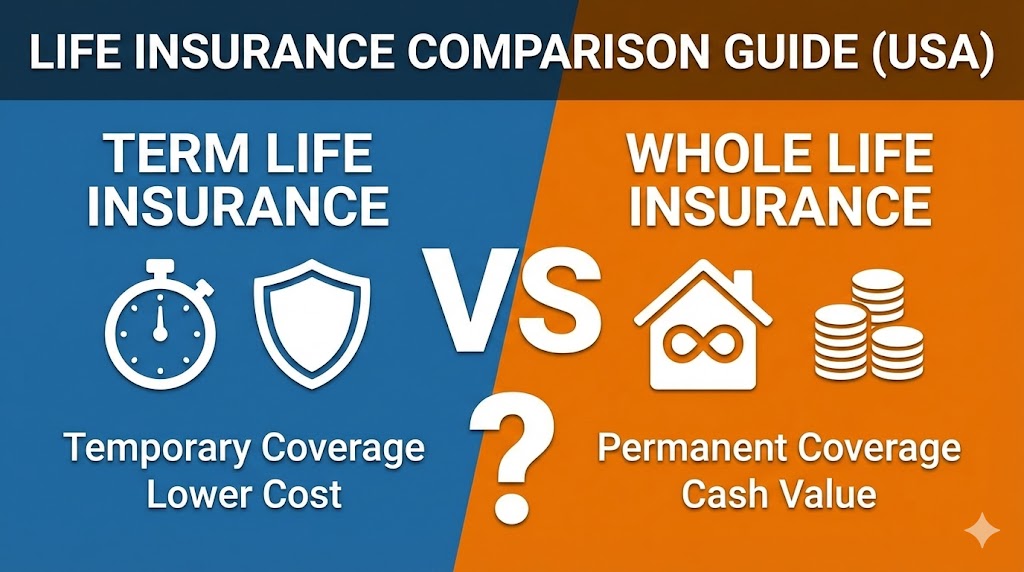
If you have ever tried to research life insurance, you have likely felt like you walked into a trap. The jargon is thick, the salespeople are aggressive, and the fear-mongering is real. You hear phrases like “building generational wealth” on one side and “buy term and invest the difference” on the other.
Who is right?
The truth is, neither type of insurance is “better” in a vacuum. They are simply different tools for different jobs. Comparing them is like comparing a hammer to a drill—you need to know what you are trying to build first.
In this guide, we will strip away the marketing fluff. We will look at real costs for 2026, explain the mechanics of “cash value,” and help you decide which policy belongs in your financial portfolio.
The Core Concept: Renting vs. Owning
Before we dive into the math, the easiest way to understand the difference is the “Rent vs. Own” analogy.
- Term Life Insurance is like renting an apartment. You pay a monthly fee to live there for a set period (the “term”). It is affordable and flexible. If you move out (the term ends), you don’t take the apartment with you. You have no equity.
- Whole Life Insurance is like buying a house. The monthly payments are much higher because you are not just paying for a place to sleep; you are building equity (cash value) that you own.1 One day, you can sell it, borrow against it, or leave it to your kids.
Is owning always better than renting? Not necessarily. If the mortgage is so expensive that you can’t afford to eat, you should have rented.
Deep Dive: Term Life Insurance
“The Pure Protection Play”
Term life insurance is the simplest form of coverage. It has one job: if you die within a specific timeframe, it pays a lump sum of cash to your beneficiaries.2
How It Works
You select a “term”—usually 10, 20, or 30 years—and a coverage amount (e.g., $500,000).3 You pay a monthly premium.4 If you die during those years, your family gets the $500,000 tax-free.
If you live past the end of the term, the policy expires.5 You get nothing back. The contract is over.
The Pros
- Affordability: This is the biggest selling point. Because the insurance company knows that most people will outlive their term (meaning the insurer never has to pay out), they can charge very low rates.
- Simplicity: There are no investment components, dividends, or confusing fees. It’s a simple trade: cash for coverage.
- High Coverage for Low Cost: A healthy 30-year-old might secure $1 million in coverage for the price of a takeout pizza per month.
The Cons
- It Expires: If you buy a 20-year term at age 30, you are uninsured at age 50. Buying a new policy then will be much more expensive because you are older.6
- No Equity: You could pay premiums for 20 years and have nothing to show for it financially if you survive.7
Who Should Buy Term?
For 90% of Americans, Term Life is the correct choice. It is ideal for people with temporary financial responsibilities.
- Parents with young kids: You need coverage until the kids are independent (roughly 20 years).
- Homeowners with a mortgage: You need coverage until the house is paid off.
- Income earners: If your spouse relies on your salary, you need coverage until you have saved enough for retirement.
Deep Dive: Whole Life Insurance
“The All-In-One Financial Tool”
Whole life insurance is a type of “permanent” insurance.8 As the name suggests, it is designed to last your whole life, as long as you keep paying the premiums.9
How It Works
Whole life is a hybrid product.10 It combines a death benefit with a savings account known as “Cash Value.”11
When you pay your monthly premium, the insurance company splits that money:
- Cost of Insurance: Pays for the death benefit.12
- Administrative Fees: Pays the company’s overhead and commissions.13
- Cash Value: Goes into a savings bucket that grows over time.14
This cash value grows at a guaranteed rate (often around 2-4%), plus potential dividends if the insurance company is profitable.15 In 2026, some major mutual insurers have announced dividend interest rates in the 5.5% to 6.0% range, though this is not a guaranteed return on your entire premium (more on that later).16
The Pros
- Guaranteed Payout: As long as you pay the premiums, your family will receive the death benefit.17 You cannot outlive this policy.
- Cash Value Access: You can borrow money from your policy tax-free while you are alive.18 This can be used for emergencies, college tuition, or buying a business.19
- Fixed Premiums: Your rate is locked in at the age you buy.20 It will never increase, even if you get cancer or develop heart disease later in life.21
The Cons
- Cost: It is significantly more expensive—often 10x to 15x the cost of term insurance for the same death benefit.22
- Complexity: Understanding dividends, surrender charges, and policy loans can be difficult.
- Slow Start: In the first few years, almost all your money goes to fees and commissions. You usually have very little cash value to show for your payments until year 5 or 10.23
Who Should Buy Whole Life?
Whole Life is generally best for people who have already maxed out other financial avenues or have specific complex needs:
- High Net Worth Individuals: Those who have already maxed out their 401(k) and IRAs and want a tax-advantaged place to store cash.24
- Estate Planning: People who know they will owe estate taxes and need liquid cash to pay them.25
- Parents of Special Needs Children: If you need to ensure funding for a child’s care that will last your entire life, not just 20 years.
The Cost Comparison (2026 Estimates)
This is where the rubber meets the road. Let’s look at the price difference for a healthy male, non-smoker, buying a $500,000 policy.
(Note: These are estimates based on 2025-2026 industry averages. Actual rates depend on health, location, and specific carrier.)
| Age at Purchase | 20-Year Term Life (Monthly) | Whole Life (Monthly) | Cost Difference (Annual) |
| 25 Years Old | ~$22 | ~$350 | $3,936 |
| 35 Years Old | ~$28 | ~$490 | $5,544 |
| 45 Years Old | ~$55 | ~$880 | $9,900 |
| 55 Years Old | ~$130 | ~$1,550 | $17,040 |
The Takeaway:
At age 35, choosing Term over Whole Life saves you roughly $462 per month. This leads to the most famous debate in the insurance world…
The “Buy Term and Invest the Difference” Strategy
Financial experts (like Dave Ramsey and Suze Orman) often advocate for this strategy. The logic is simple:
Instead of paying $490/month for Whole Life, you pay $28/month for Term Life. You then take the extra $462 you “saved” and invest it in a low-cost S&P 500 index fund or a Roth IRA.
The Math Over 30 Years:
- Scenario A (Whole Life): You pay $490/month. After 30 years, you have a death benefit of $500,000 and a cash value of roughly $250,000 (depending on dividends).
- Scenario B (Buy Term + Invest): You pay $28/month for insurance. You invest $462/month in the market at a conservative 7% return.
- After 30 years, your Term policy expires (you have no insurance).26
- BUT, your investment account has grown to approximately $550,000.
The Verdict:
In Scenario B, you are “self-insured.” You don’t need the life insurance anymore because you have half a million dollars in cash. For disciplined savers, “Buy Term and Invest the Difference” almost always mathematically beats Whole Life insurance.
The “Discipline” Trap:
The flaw in this strategy is human behavior. Most people don’t invest the difference. They buy the cheap term policy and then spend the extra $462 on car payments, dinners, and vacations. If you lack discipline, the “forced savings” of Whole Life might actually result in you having more money later.
Busting Common Myths
Myth 1: “Term Life is throwing money away.”
Truth: Is car insurance throwing money away if you don’t crash? Is health insurance a waste if you don’t get sick? No. You are buying risk transfer. You are paying a small fee to transfer the financial risk of your death from your family to the insurance company. That is a valuable service, even if you never use it.
Myth 2: “Whole Life is an investment.”
Truth: It is better to think of Whole Life as a “savings account on steroids” rather than an investment. The returns (historically 3-5% internal rate of return over the long haul) generally cannot compete with the stock market (historically 7-10%). It is a safe asset, not a high-growth asset.
Myth 3: “You can withdraw your cash value whenever you want.”
Truth: You can, but it’s often a loan.27 The insurance company lends you their money and uses your cash value as collateral.28 If you don’t pay it back, they deduct it from the death benefit when you die.29 Also, in the first 5-10 years, “surrender charges” can eat up a huge chunk of your cash if you try to cancel the policy.
Myth 4: “I can get Whole Life later if I need it.”
Truth: Technically yes, but it will be much more expensive.30 Life insurance gets pricier every year you age.31 If you develop a health condition (diabetes, high blood pressure) in your 40s, you might become “uninsurable” or face exorbitant premiums.
Comparison: The Features at a Glance
| Feature | Term Life Insurance | Whole Life Insurance |
| Duration | Temporary (10-30 years) | Permanent (Lifelong) |
| Cash Value | None | Yes (Guaranteed growth) |
| Premiums | Low (Fixed for the term) | High (Fixed for life) |
| Death Benefit | Guaranteed during term | Guaranteed for life |
| Dividends | No | Yes (if from a Mutual company) |
| Complexity | Low | High |
| Best For | Income replacement, Debt coverage | Estate planning, Legacy, Tax diversification |
Frequently Asked Questions (FAQs)
Q: Are life insurance proceeds taxable?
A: Generally, no. The death benefit paid to your beneficiary is tax-free.32 However, if you surrender a Whole Life policy for cash, you may have to pay income tax on any gains (the amount above what you paid in premiums).
Q: What happens if I stop paying premiums?
- Term Life: The policy lapses. You are no longer covered.
- Whole Life: It depends. If you have cash value, the company might use it to pay the premiums for you (Automatic Premium Loan) to keep the policy alive.33 If you run out of cash value, the policy lapses.
Q: Can I convert Term to Whole Life?
A: Yes, most Term policies have a “conversion rider.”34 This allows you to trade your Term policy for a Whole Life policy without taking a new medical exam. This is a great safety net if you get sick during your term and want to extend coverage permanently.
Q: Do I need a medical exam?
A: For the best rates, yes. A nurse will come to your house to check your height, weight, blood pressure, and take a blood sample. There are “No-Exam” policies available (using algorithms and data records), but they are typically slightly more expensive or have lower coverage limits.
Q: What is “Universal Life” insurance?
A: Universal Life is a cousin of Whole Life.35 It is permanent, but flexible. You can adjust your monthly premiums up or down. However, it carries more risk; if the company’s interest rates drop, your premiums might skyrocket later in life to keep the policy from collapsing. Whole Life is more rigid but more secure.
Final Verdict: Which One Should You Choose?
Making the right choice comes down to your life stage and financial discipline.
Choose Term Life If:
- You are under 50 and healthy.36
- You have a limited budget.
- Your main goal is replacing your income to protect your spouse/kids.
- You have debt (mortgage, student loans) that will disappear over time.
- You are disciplined enough to save for retirement in 401(k)s and IRAs.
Choose Whole Life If:
- You have a high net worth and need tax diversification.37
- You want to leave a guaranteed legacy to heirs regardless of when you die.38
- You have a lifelong dependent (e.g., special needs child).39
- You are ultra-conservative and want a “safe bucket” of money that isn’t tied to the stock market.
The Golden Rule: The worst policy is the one you can’t afford.
Do not let an agent pressure you into a Whole Life policy that stretches your budget. It is better to have a cheap Term policy that you can easily afford than a Whole Life policy you have to cancel in two years because the premiums are suffocating you.40
Start with what you need to protect today. For most families, a simple, affordable Term Life policy is the foundation of a solid financial plan.

玩pt888vip也有些日子了,小赢过几次,也小亏过几次,总的来说体验还行,就当是娱乐了,别太上头就好。点击看看pt888vip。