
Introduction: The Borrowing Landscape of 2026
If you are reading this in 2026, you know the financial world has shifted. After the volatile inflation of the early 2020s and the subsequent rate hikes, 2026 has brought a period of “cautious stabilization.” The Federal Reserve’s policies have settled, but borrowing money isn’t as cheap as it was a decade ago.
Whether you are looking to consolidate high-interest credit card debt, finance a dream wedding, or handle an unexpected medical emergency, a personal loan remains one of the most versatile tools in your financial toolkit. But versatility comes at a price.
In 2026, the gap between a “good” interest rate and a “bad” one has widened. A borrower with a 750 FICO score might secure a 7% APR, while someone with a 640 score could be staring at 28%.
This guide is written to help you navigate this divide. We will cut through the banking jargon to explain exactly how personal loan rates work this year, the difference between getting a loan from a sleek app versus a stone-pillar bank, and the specific strategies you can use to slash your costs.
Part 1: Current Personal Loan Interest Rates (2026 Forecast)
Interest rates are not static; they are alive, moving with the economy. In 2026, the average personal loan interest rate sits around 12.2% across all credit profiles. However, “average” is a dangerous word in finance because it hides the extremes.
Here is the realistic breakdown of what you can expect to pay based on your credit tier right now.
The 2026 Rate Brackets
| Credit Score Range | FICO Score | Estimated APR (2026) | Lender Perception |
| Excellent | 760 – 850 | 6.99% – 9.50% | The “VIP” Borrower. You get the doorbuster rates. |
| Very Good | 720 – 759 | 9.50% – 13.00% | The Preferred Borrower. Solid rates, competitive offers. |
| Good | 670 – 719 | 13.00% – 19.00% | The Standard Borrower. You have options, but shop carefully. |
| Fair | 580 – 669 | 19.00% – 29.00% | The “Subprime” Borrower. High risk, high cost. |
| Poor | < 580 | 30.00% – 36.00% | The High-Risk Borrower. Very limited options. |
Expert Insight: Notice the massive jump between “Good” and “Fair.” If your score is currently hovering around 660, spending two months boosting it to 680 could save you literally thousands of dollars in interest over the life of a loan.
Part 2: Banks vs. Online Lenders – The Battle for Your Business
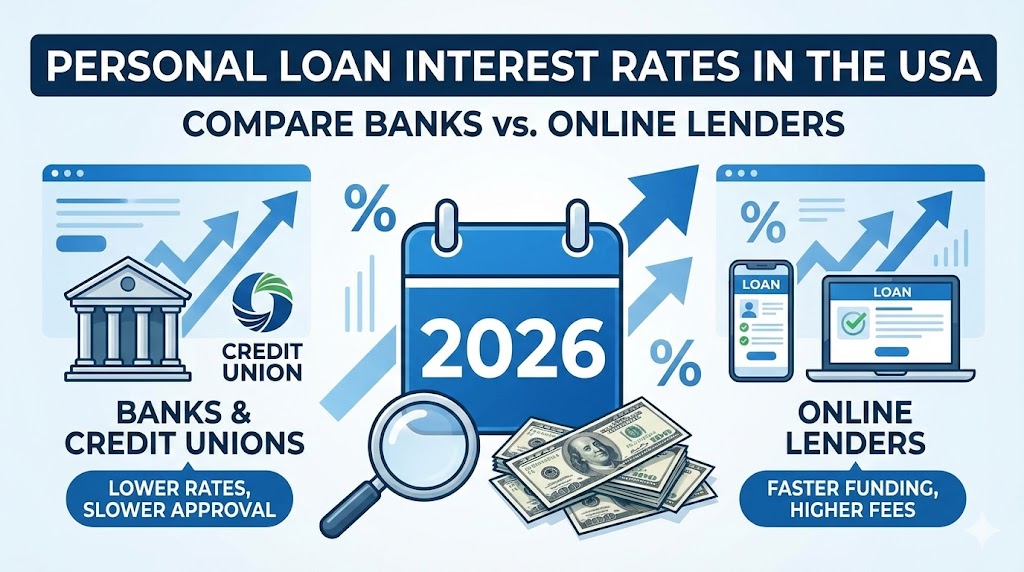
In 2026, you essentially have two places to get money: traditional brick-and-mortar banks (like Wells Fargo, Citibank, or your local Credit Union) and fintech online lenders (like SoFi, LightStream, or Upstart).
Which one wins? That depends entirely on what you value more: Speed or Relationship.
1. Traditional Banks & Credit Unions
The Vibe: Old school, rigorous, but often cheaper for loyalists.
- Pros:
- Loyalty Discounts: Many banks in 2026 offer a “Relationship Discount” (usually 0.25% to 0.50% off the APR) if you already have a checking account with them.
- Security: There is a comfort factor in knowing you can walk into a branch if something goes wrong.
- No Origination Fees: Major banks rarely charge origination fees (the fee to process the loan), which can save you 1% to 6% upfront.
- Cons:
- Slower Funding: It might take 3 to 7 business days to see the cash.
- Harder Approval: Banks are conservative. They often prefer scores above 700 and low Debt-to-Income (DTI) ratios.
2. Online Lenders (Fintech)
The Vibe: Fast, digital, and algorithm-driven.
- Pros:
- Lightning Speed: Many online lenders in 2026 utilize AI underwriting. You can apply at 9:00 AM and have funds in your account by 5:00 PM the same day.
- Broader Eligibility: They look beyond just the FICO score. Lenders like Upstart use alternative data (education, job history) to approve people banks might reject.
- Soft Credit Check: Almost all online lenders allow you to “Check Your Rate” without hurting your credit score.
- Cons:
- Origination Fees: This is the hidden trap. An online lender might offer you 12% APR but charge a 5% origination fee. On a $10,000 loan, they take $500 right off the top, leaving you with only $9,500.
- Impersonal: If you miss a payment, you are dealing with a customer service bot or call center, not a local banker who knows your name.
The Verdict:
- Choose a Bank if: You have excellent credit (740+) and can wait a week.
- Choose Online if: You need money fast, have “Fair” credit, or want to compare 10 rates in 10 minutes.
Part 3: The “Big Three” Factors That Determine Your Rate
Why does your neighbor get 8% while you get 14%? Lenders in 2026 use a specific “Risk Algorithm.” Here are the three levers that control it.
1. Your Credit Score (The King)
We discussed the brackets above, but here is the nuance: Lenders look at trend. Is your score 680 because it’s climbing up from 500, or because it’s crashing down from 750? A crashing score is a red flag.
2. Debt-to-Income Ratio (DTI)
This is the math finance nerds love. It is the percentage of your gross monthly income that goes toward paying debts.
- Formula: (Total Monthly Debt Payments / Gross Monthly Income) x 100
- The Sweet Spot: In 2026, lenders love a DTI below 36%.
- The Danger Zone: If your DTI is above 43%, you will likely face higher rates or rejection. Lenders worry you are “over-leveraged.”
3. Collateral (Secured vs. Unsecured)
Most personal loans are unsecured, meaning they are backed only by your promise to pay. This is risky for the lender, hence the higher rate.
If you are struggling to get approved, look for Secured Personal Loans. By pledging your car or a savings account as collateral, you can often slash your interest rate by 3-5%. Warning: If you default, they take your car.
Part 4: Eligibility & Documents (The 2026 Checklist)
Getting rejected for a loan hurts your credit score (due to the “Hard Inquiry”). To avoid this, ensure you meet the criteria before you click “Apply.”
Basic Eligibility Criteria
- Age: 18+ (or state majority age).
- Citizenship: US Citizen or Permanent Resident (Green Card). Note: Some specialized lenders now serve visa holders, but rates are higher.
- Income: Generally, you need an annual income of at least $24,000, though premium lenders may require $40,000+.
- Bank Account: You must have a verifiable checking account in your name (for the deposit).
The Document Vault (Have These Ready PDF-Style)
In 2026, you don’t fax papers. You upload PDFs. Have these four files on your desktop:
- Proof of Identity: A clear color scan of your Driver’s License or Passport.
- Proof of Income (Salaried): Your last 2 pay stubs and your most recent W-2 form.
- Proof of Income (Self-Employed): This is trickier. Have your last 2 years of Tax Returns (1040s) and 3 months of bank statements ready.
- Proof of Address: A utility bill (electric/water) or lease agreement from the last 60 days.
Pro Tip: Ensure the address on your ID matches the address on your utility bill. A mismatch triggers a “Fraud Alert” in banking systems, delaying your loan by days.
Part 5: Master Your EMI (Equated Monthly Installment)
Taking the loan is easy; paying it back is the grind. A “Personal Loan” is an installment loan, meaning you pay a fixed amount every month. Here is how to manage it like a pro.
1. The Tenure Trap
You will typically choose a term between 2 to 7 years (24 to 84 months).
- The Trap: A 5-year loan has a much lower monthly payment than a 3-year loan. It looks tempting.
- The Reality: The longer the term, the higher the interest rate and the more interest you pay in total.
- Example ($10,000 Loan):
- 3 Years @ 10%: Monthly Pay = $323. Total Interest = $1,616.
- 5 Years @ 12%: Monthly Pay = $222. Total Interest = $3,347.
- Result: The lower monthly payment cost you $1,700 extra. Always pick the shortest term you can comfortably afford.
- Example ($10,000 Loan):
2. The Autopay Hack
95% of lenders in 2026 offer an Autopay Discount (usually 0.25%).
- Action: The moment you are approved, set up autopay. On a large loan, that 0.25% discount can save you enough for a nice dinner out.
3. The Prepayment Strategy
Most legit personal loans in 2026 have No Prepayment Penalties. This means you can pay the loan off early for free.
- Strategy: If you get a tax refund or a work bonus, throw it at the loan principal. Even one extra payment a year can shorten your loan term by months and save you interest.
Part 6: Step-by-Step Guide to Applying
Don’t just apply to the first bank you see on Google. Follow this “Rate Shopping” method to protect your credit score.
- Prequalify Everything: Go to 3-5 different lender websites (or a marketplace like Credible/NerdWallet) and use the “Check My Rate” tool. This is a soft pull.
- Compare APR vs. APR: Do not compare “Interest Rate.” Compare “APR” (Annual Percentage Rate). The APR includes the interest rate plus the origination fees. It is the true cost of the loan.
- Gather Your Documents: See the checklist above.
- Submit One Application: Once you pick the winner, submit the formal application. This will trigger a “Hard Inquiry” (dropping your score by ~5 points temporarily).
- Verification Call: You may receive a call to verify your identity. Answer it, or your loan will stall.
Part 7: Frequently Asked Questions (FAQs)
Q: Will checking my rate hurt my credit score?
A: No. As long as the lender specifies it is a “Soft Inquiry” or “Prequalification,” it is invisible to other lenders and does not hurt your score. Your score only drops when you submit the final application.
Q: Can I get a personal loan with bad credit (Score < 600)?
A: Yes, but it is expensive. You will likely be looking at online lenders or credit unions. APRs can hit 35.99%. Be very careful of “Payday Loans” disguised as personal loans—if the APR is over 36%, run away.
Q: How can I use a personal loan to improve my credit score?
A: If you have high-balance credit cards, taking a personal loan to pay them off (Debt Consolidation) can boost your score. It lowers your “Credit Utilization Ratio,” which is a major scoring factor. Plus, personal loans are considered “Installment Credit,” which adds a healthy “Credit Mix” to your profile.
Q: Is the interest on a personal loan tax-deductible?
A: Generally, no. Unlike mortgage interest or student loan interest, personal loan interest is not deductible. The only exception is if you can prove the money was used exclusively for business expenses, but talk to a CPA first.
Q: What is the difference between Fixed and Variable rates?
A:
- Fixed Rate: Your interest rate never changes. Your monthly payment is exactly the same for 3 years. (Recommended for 90% of people).
- Variable Rate: The rate can go up or down based on the Federal Reserve. It might start lower than a fixed rate, but if the economy changes, your payment could skyrocket. In 2026, fixed rates are generally the safer bet.
Conclusion: Is 2026 the Year You Borrow?
Personal loans are a double-edged sword. Used correctly—to consolidate toxic debt, invest in home improvements that add value, or handle emergencies—they are a financial lifesaver. Used poorly—to fund a lifestyle you can’t afford—they are a trap.
The key takeaway for 2026 is comparison. The market is flooded with lenders competing for your business. Use that to your advantage. Make them fight for you. Don’t settle for the first offer, watch out for origination fees, and always, always read the fine print.
Ready to start?
- Next Step: Log in to your credit card provider’s app or Credit Karma today and check your current FICO score. Knowing that number is the first step to unlocking the best rates in the market.
