
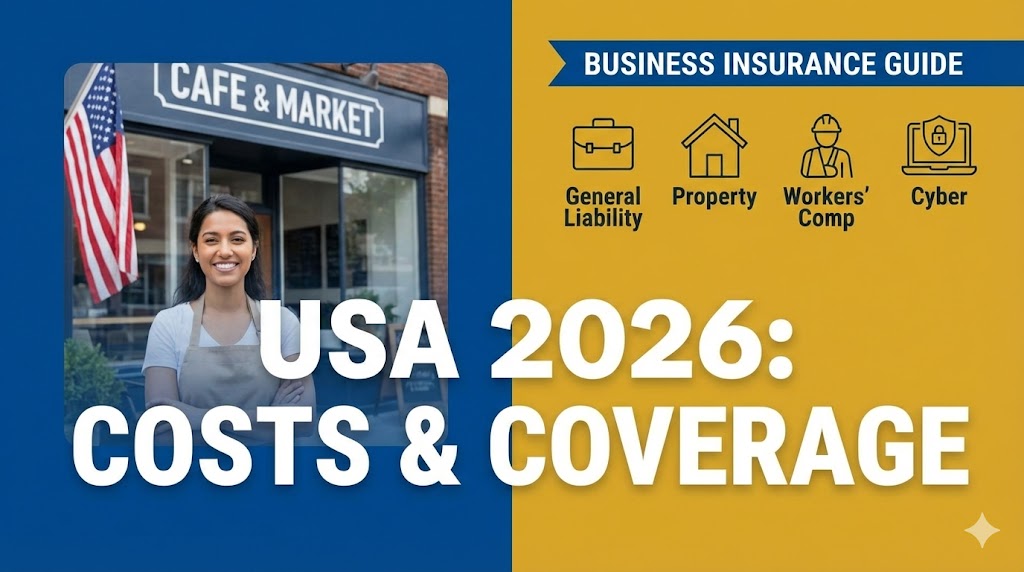
Running a small business is a high-wire act. You balance cash flow, customer satisfaction, and growth daily. But one misstep—a lawsuit, a data breach, or a natural disaster—can bring the whole show crashing down. This is where business insurance becomes your safety net.
In 2026, the insurance landscape has shifted. With rising medical costs, inflation, and new cyber threats, “being careful” is no longer enough. This guide provides a neutral, trustworthy breakdown of what you need, what it costs, and how to protect your life’s work without overspending.
Why Small Businesses Need Insurance (Beyond “Peace of Mind”)
Many entrepreneurs view insurance as a “grudge purchase”—something you buy only because you have to. However, in the current US legal climate, it is a financial necessity.
- Litigation Risk: The average cost of a slip-and-fall lawsuit in the US can exceed $20,000, not including legal fees.
- Client Contracts: Many corporate clients and landlords now mandate proof of insurance before signing a contract or lease.
- Employee Protection: If you have staff, you are legally responsible for their safety.1 A single workplace injury can bankrupt an uninsured company.
Core Types of Business Insurance
Not every business needs every policy. However, these are the foundational pillars most US small businesses should consider.
1. General Liability Insurance (GLI)
Who needs it: Almost everyone.
What it covers: This is your first line of defense. It covers third-party bodily injury, property damage, and advertising injury (like libel or slander).2
- Example: A customer trips over a loose cable in your office and breaks their wrist. GLI pays for their medical bills and your legal defense.3
2. Professional Liability Insurance (E&O)
Who needs it: Consultants, accountants, real estate agents, and anyone providing advice.4
What it covers: Also known as Errors and Omissions (E&O) insurance, this protects you against claims of negligence, misrepresentation, or inaccurate advice.5
- Example: A web developer launches a site with a security flaw that costs the client sales. The client sues for lost revenue.
3. Commercial Property Insurance
Who needs it: Businesses with physical assets (retail stores, offices, manufacturers).6
What it covers: Protects your building, inventory, equipment, and furniture from fire, theft, vandalism, and storms.7
- Note: Standard policies often exclude floods and earthquakes. You may need separate riders for these.
4. Workers’ Compensation Insurance
Who needs it: Businesses with employees (mandatory in almost every state).8
What it covers: Medical costs and lost wages for employees injured on the job.9 It also protects you from being sued by the employee for that injury.10
- Legal Alert: In states like California and New York, you must have this the moment you hire your first employee.
5. Cyber Liability Insurance
Who needs it: Anyone who stores customer data or takes credit card payments.11
What it covers: Costs related to data breaches, including notifying customers, legal fees, and paying ransomware demands (depending on the policy).12
- 2026 Trend: With AI-driven cyber attacks on the rise, this is becoming as essential as General Liability for digital-first businesses.
6. Business Owner’s Policy (BOP)
Who needs it: Small to mid-sized businesses looking for value.
What it is: A “bundle” that combines General Liability and Commercial Property into one policy, often at a cheaper rate than buying them separately.13
Average Costs in 2026
Insurance premiums vary wildly based on industry, location, and revenue.14 However, recent data provides these rough monthly averages for small businesses in the USA:
| Insurance Type | Average Monthly Cost | Cost Factors |
| General Liability | $42 – $65 | High foot traffic = Higher cost. |
| Workers’ Comp | $45 – $80 | High physical risk (e.g., construction) = Higher cost. |
| Prof. Liability (E&O) | $60 – $100 | High contract value = Higher cost. |
| Cyber Liability | $145 – $200 | Volume of sensitive data stored. |
| Business Owner’s Policy | $57 – $120 | Combined asset value and risk. |
- Pro Tip: Paying annually rather than monthly can often save you 10-15% on premiums.
Legal Requirements by State
Insurance laws in the US are state-specific.15 Here is a general breakdown of mandatory requirements:
- Workers’ Compensation: Required in 49 states (Texas is the notable exception where it is optional for many employers). Some states require it for 1+ employees, others for 3-5+.
- Commercial Auto: If your business owns vehicles, every state requires commercial auto liability insurance. Personal auto policies will not cover accidents that happen while making business deliveries.16
- Disability Insurance: A handful of states (California, Hawaii, New Jersey, New York, Rhode Island) require employers to provide short-term disability insurance.
- Professional Licensing: Doctors, lawyers, and contractors often need specific liability limits to maintain their state licenses.17
The Claim Process: Step-by-Step
Filing a claim can be stressful. Knowing the procedure beforehand helps reduce panic.18
- Secure the Scene: If there is a fire or injury, call 911 immediately. Prevent further damage (e.g., board up a broken window), but do not throw away damaged goods until an adjuster sees them.
- Notify Your Insurer: Call your agent or use your carrier’s app immediately. Most policies have a “prompt notice” clause.
- Document Everything: Take photos and videos of the damage.19 Collect names/contacts of witnesses. Keep a log of every conversation you have regarding the incident.
- Meet the Adjuster: The insurance company will send an adjuster to inspect the damage.20 Be honest, but stick to the facts. Do not speculate on the cause if you don’t know.
- Review the Settlement: The insurer will offer a payout. If it covers your losses, accept it. If not, you have the right to appeal or hire a public adjuster to advocate for you.
5 Common Mistakes to Avoid
- Underinsuring Assets: If your inventory is worth $100,000 but you only insure it for $50,000 to save on premiums, you will only get a fraction of the payout in a total loss.
- Misclassifying Employees: Listing a roofer as a “clerical worker” to save on Workers’ Comp is fraud. When they get injured, the claim will be denied, and you could face heavy fines.
- Relying on Personal Insurance: Homeowner’s policies rarely cover business equipment or business-related liability.21 If you run a business from your garage, you likely need a home-based business rider.
- Ignoring the “Claims-Made” Trigger: Some policies (like E&O) are “claims-made.” This means you must have the policy active both when the error happened and when the lawsuit is filed. If you cancel the policy, you lose coverage for past work unless you buy “tail coverage.”
- Not Updating the Policy: Did you buy new expensive equipment? Hire more staff? Expand to a new state? If you don’t update your policy, your new assets/risks are uninsured.
Frequently Asked Questions (FAQs)
Q: Can I write off business insurance on my taxes?
A: Generally, yes. The IRS considers business insurance premiums a “cost of doing business,” making them fully tax-deductible. Always consult a CPA to confirm.
Q: What is the difference between an “Independent Agent” and a “Captive Agent”?
A: A Captive Agent works for one specific company (e.g., State Farm) and can only sell their products. An Independent Agent works with multiple carriers (e.g., Travelers, Hartford, Chubb) and can shop around to find you the best rate.22
Q: Do LLCs need insurance?
A: Yes. While an LLC structure protects your personal assets from business debts, it does not protect your business bank account from being drained by a lawsuit. Insurance protects the business’s assets.23
Q: How do I get a Certificate of Insurance (COI)?
A: Your insurance agent can email this to you, usually within hours. A COI is a single-page document that proves to clients or landlords that you have active coverage.
Q: Does General Liability cover data breaches?
A: No. Standard GL policies specifically exclude cyber incidents. You must purchase a separate Cyber Liability policy or an endorsement.
Conclusion
Business insurance in the USA is not just a regulatory hurdle; it is a strategic asset. It transfers the risk of the “unknown” from your bank account to the insurance carrier.
Your Next Steps:
- Audit your risks: specific to your industry (e.g., do you drive a lot? do you handle data?).
- Gather documents: Payroll info, revenue projections, and asset values.24
- Shop around: Get quotes from at least three providers or use an online broker to compare.25
