
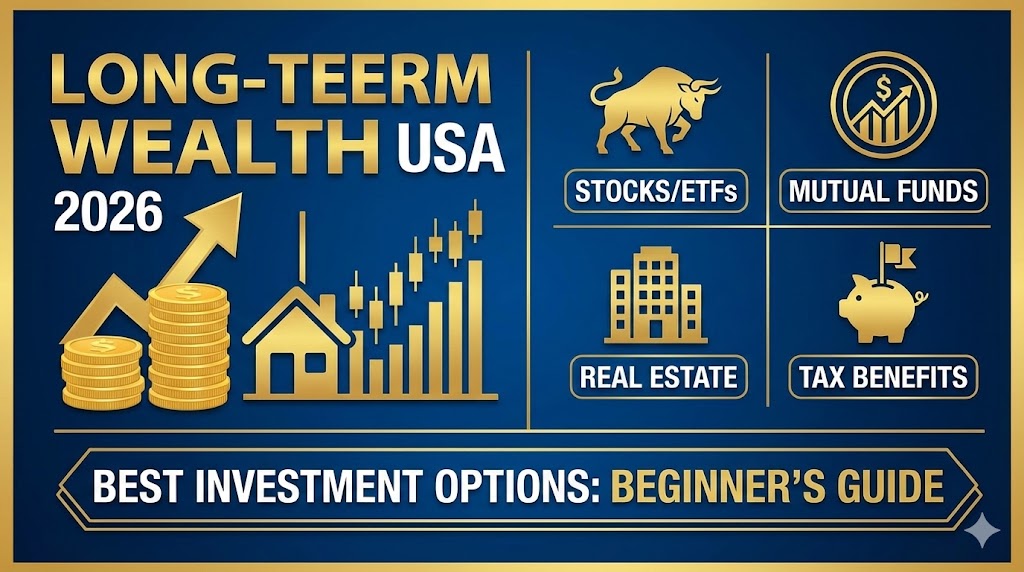
If you kept your money under a mattress in 1990, $100 would buy you a week’s worth of groceries. In 2026, that same $100 bill might barely cover a nice dinner for two.
The silent enemy of wealth is inflation. The only way to beat it—and achieve financial freedom—is to make your money work harder than you do. This is the essence of long-term investing.
But where do you start? The US financial market is the largest and most liquid in the world, offering an overwhelming menu of options. From the stock market to real estate, and from boring bonds to exciting ETFs, the choices can paralyze a beginner.
This guide is designed to cut through the noise. We will explore the best investment vehicles available to US residents, explain the tax “hacks” the wealthy use, and help you build a portfolio that lets you sleep at night.
Part 1: The Core Concepts (Read This First)
Before you buy a single stock, you must understand the two forces that will determine your success.
1. Compound Interest: The Eighth Wonder of the World
Investing is not about “getting rich quick.” It is about getting rich slowly and inevitably.
- Simple Interest: You earn interest only on your principal (the original money).
- Compound Interest: You earn interest on your principal plus the interest you already earned.
Example: If you invest $500 a month for 30 years at an 8% average return:
- Total money you put in: $180,000
- Total value at the end: $745,000
- That extra $565,000 is free money generated by compounding.
2. Risk vs. Reward
There is no such thing as a “high return, zero risk” investment. If someone offers you that, it is a scam (or a Ponzi scheme).
- Low Risk: Savings accounts, Government Bonds. (Returns: 3-5%). Keeps up with inflation.
- Medium Risk: ETFs, Blue-chip stocks, Real Estate. (Returns: 7-10%). Builds wealth.
- High Risk: Crypto, Individual Growth Stocks, Startups. (Returns: -100% to +1,000%). Gambling territory.
Part 2: The Best Investment Vehicles for 2026
Here are the top five engines for driving long-term wealth in the USA.
Option 1: Exchange Traded Funds (ETFs)
Risk Level: Low to Medium Potential Return: 8% – 10% (Average historical market return) Best For: The “Set it and Forget it” Investor.
If you only read one section of this article, make it this one. An ETF is a basket of stocks. Instead of trying to pick the “winner” (like betting on Apple vs. Microsoft), you buy the whole basket.
- The S&P 500 ETF: This buys a tiny slice of the 500 largest companies in America. If the US economy grows, you make money.
- Popular Tickers: VOO (Vanguard), SPY (SPDR), IVV (iShares).
- Total Stock Market ETF: Why stop at 500? These funds buy essentially every public company in the US.
- Popular Tickers: VTI, SCHB.
Why it wins:
- Instant Diversification: One share gives you ownership in 500+ companies. If one goes bankrupt, you barely notice.
- Low Fees: Expense ratios are often 0.03% (you pay $3 a year for every $10,000 invested).
- Self-Cleansing: Bad companies drop out of the index; new, growing companies replace them automatically.
Option 2: Individual Stocks
Risk Level: High Potential Return: Unlimited (or 100% loss) Best For: Investors willing to do homework.
Buying individual stocks means becoming a partial owner of a specific business. If you bought NVIDIA in 2015, you are likely retired today. If you bought Bed Bath & Beyond in 2020, you lost everything.
- Blue Chip Stocks: Giant, stable companies (e.g., Coca-Cola, Johnson & Johnson). They often pay dividends (cash payouts) to shareholders. They won’t double overnight, but they are unlikely to go bust.
- Growth Stocks: Tech companies or startups (e.g., Tesla, AI firms). They reinvest all profits to grow. The stock price can swing wildly.
Strategy: Limit individual stocks to 5-10% of your portfolio. Treat it as your “fun money,” not your retirement safety net.
Option 3: Mutual Funds
Risk Level: Medium Potential Return: Varies Best For: 401(k) accounts and hands-off investors.
Mutual funds are similar to ETFs (baskets of stocks), but they are often actively managed. A professional fund manager tries to pick the best stocks to beat the market.
The Downside: Because you are paying for a human manager, the fees are higher (often 0.5% to 1.5%).
- Statistically, 80%+ of active fund managers fail to beat the simple S&P 500 ETF over a 15-year period.
- Warning: Watch out for “Sales Loads” (fees just to buy or sell the fund). Stick to “No-Load” funds.
Option 4: Real Estate
Risk Level: Medium to High Potential Return: Appreciation + Rental Income Best For: People who want tangible assets.
Real estate is a favorite of the wealthy because it offers leverage. You can buy a $400,000 asset with only $80,000 cash (20% down payment).
Two Ways to Invest:
- Physical Property: Buying a rental home.
- Pros: Tax deductions, tenants pay your mortgage, property appreciates.
- Cons: Toilets break, tenants don’t pay, and it requires work.
- REITs (Real Estate Investment Trusts): This is “Real Estate for Lazy People.”
- A REIT is a company that owns office buildings, malls, or apartments. You buy shares of the REIT on the stock market (just like a stock).
- Law: By law, REITs must pay out 90% of their taxable income to shareholders as dividends. This makes them great for passive income.
- Popular Examples: O (Realty Income), VNQ (Vanguard Real Estate ETF).
Option 5: Bonds and Treasury Bills
Risk Level: Very Low Potential Return: 4% – 6% Best For: Preserving wealth and older investors.
Stocks are for growing wealth; bonds are for keeping it. When you buy a bond, you are lending money to a company or the government. They promise to pay you back with interest.
- US Treasury Bills (T-Bills): Backed by the “full faith and credit” of the US government. Considered the safest investment on earth.
- Corporate Bonds: Lending money to companies like Microsoft or Ford. Slightly riskier, so they pay higher interest.
Strategy: As you get closer to retirement, shift money from Stocks (volatile) to Bonds (stable) to protect your nest egg from a market crash.
Part 3: The “Supercharged” Tax Accounts
In the USA, where you put your investments is just as important as what you buy. The government offers special accounts to encourage saving.
1. The 401(k) – The Employer Match
This is offered through your job. You contribute money directly from your paycheck before taxes are taken out.
- The Golden Rule: If your employer offers a “match” (e.g., they match 50% of your contribution up to 6%), take it. That is an instant, guaranteed 50% return on investment. No market investment can beat that.
2. The Roth IRA – Tax-Free Growth
This is the holy grail for young investors.
- You contribute money after you pay taxes on it.
- The Magic: The money grows tax-free. When you retire (after age 59½), you can withdraw millions of dollars, and the IRS gets $0.
- 2026 Limit: You can generally contribute up to $7,000 (or $8,000 if over 50) per year, subject to income limits.
3. The Traditional IRA
- You contribute pre-tax money (lowering your tax bill today).
- The money grows tax-deferred.
- You pay taxes when you withdraw it in retirement.
- Best for: People currently in a very high tax bracket who expect to be in a lower bracket when they retire.
Part 4: A Sample Strategy for Beginners
If you are overwhelmed, here is a simple “Three-Fund Portfolio” strategy that outperforms most professional hedge funds over 30 years.
The Allocation:
- 60% Total US Stock Market (e.g., VTI): Captures the growth of the American economy.
- 20% International Stock Market (e.g., VXUS): Captures growth in Europe, Asia, and emerging markets.
- 20% Total Bond Market (e.g., BND): Provides stability and income.
The Method: Dollar Cost Averaging (DCA) Do not try to “time the market.” Do not wait for a crash. Instead, invest a fixed amount (e.g., $500) on the same day every month, regardless of whether the market is up or down.
- When the market is down, your $500 buys more shares (buying on sale).
- When the market is up, your portfolio value grows.
Part 5: The Risks You Must Know
Investing is not all sunshine and dividends. Here are the dragons that can burn your portfolio.
1. Market Volatility
The stock market crashes. It happened in 2000, 2008, 2020, and it will happen again.
- The Risk: Panic selling. If you sell when your portfolio drops 30%, you lock in the loss.
- The Fix: Do not look at your account during a crash. History shows the US market has always recovered to new highs eventually.
2. Inflation Risk
This is the risk of doing nothing. If your money is in a checking account earning 0.01%, and inflation is 3%, you are losing purchasing power every year.
3. Emotional Trading
The biggest enemy is the person in the mirror. FOMO (Fear Of Missing Out) leads people to buy hyped stocks at the top (like GameStop in 2021) and sell good investments at the bottom out of fear.
Part 6: Frequently Asked Questions (FAQs)
Q: How much money do I need to start? A: In 2026, you can start with $1. Apps like Fidelity, Robinhood, and Schwab allow “Fractional Shares.” You can buy $5 worth of Amazon or Google.
Q: Should I pay off debt before investing? A: It depends on the interest rate.
- High-Interest Debt (Credit Cards, >10%): Pay this off first. It is a guaranteed negative return.
- Low-Interest Debt (Mortgage, <6%): You are likely better off investing, as market returns (avg 8-10%) usually beat the loan interest.
Q: Is crypto a good investment? A: Crypto (Bitcoin, Ethereum) is a speculative asset, not an investment in the traditional sense. It produces no cash flow (unlike a company or rental house). Allocate no more than 1-5% of your portfolio to it.
Q: What happens if the stock market goes to zero? A: If the S&P 500 goes to zero, it means the 500 largest US companies (Apple, Microsoft, Walmart, Exxon) have all gone bankrupt simultaneously. If that happens, money will be the least of your problems; we will be living in a Mad Max apocalypse.
Q: Can I access my retirement money early? A: Generally, no. There are heavy penalties (10% + taxes) for withdrawing from a 401(k) or IRA before age 59½. However, with a Roth IRA, you can withdraw your contributions (but not the earnings) anytime, penalty-free.
Conclusion: The Best Time to Plant a Tree
There is an old Chinese proverb: “The best time to plant a tree was 20 years ago. The second best time is today.”
You do not need to be a Wall Street expert to build wealth. You need patience, consistency, and a plan.
Your Action Plan for This Week:
- Open a Brokerage Account: Fidelity, Vanguard, or Charles Schwab are the most reputable.
- Max the Match: If your employer offers a 401(k) match, sign up immediately.
- Buy the Haystack: Set up an automatic monthly transfer to buy a low-cost S&P 500 ETF (like VOO).
- Wait: Go live your life. Let compounding do the heavy lifting.
Investing is the long game. Start today, and your future self will thank you.
