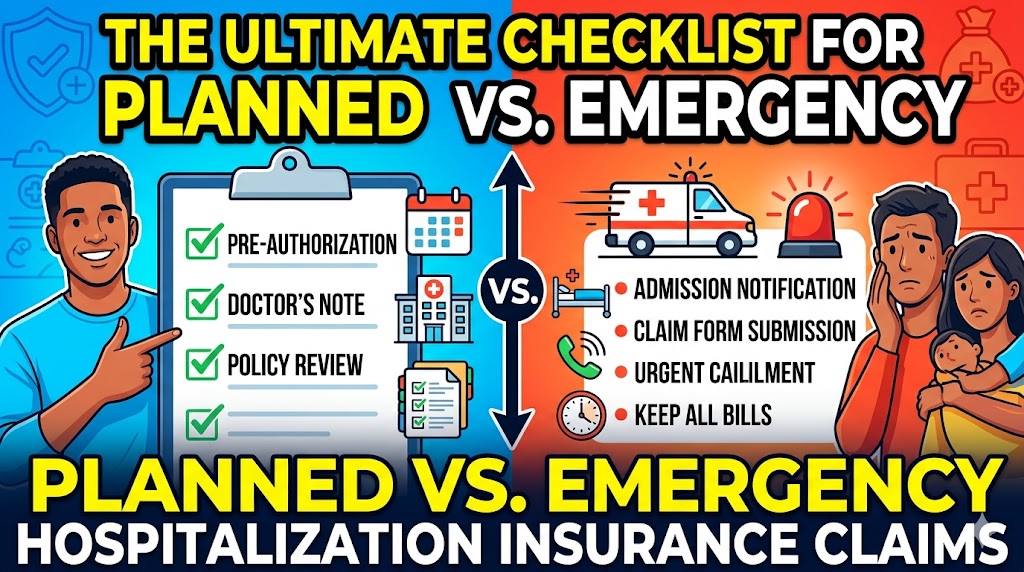
Health insurance can significantly reduce the financial burden of medical treatment, but filing a successful claim often depends on following the correct procedures. Many policyholders purchase health insurance expecting smooth claim settlement, only to encounter delays, document requests, or claim disputes because they were unaware of the process. The requirements for a planned hospitalization claim can be very different from those for an emergency hospitalization claim.
Understanding these differences is essential because insurance companies have specific timelines, documentation standards, and notification requirements for each situation. Whether you are preparing for a scheduled surgery or dealing with an unexpected medical emergency, having a clear checklist can help ensure faster approvals and smoother claim settlement.
This comprehensive guide explains the key differences between planned and emergency hospitalization claims and provides a step-by-step checklist to help policyholders navigate both scenarios successfully.
Understanding Hospitalization Insurance Claims
A hospitalization insurance claim is a request submitted to an insurance company for reimbursement or direct payment of medical expenses incurred during hospital treatment.
Claims generally fall into two categories:
- Planned hospitalization claims
- Emergency hospitalization claims
Although both involve medical treatment covered by health insurance, the claim procedures differ because planned hospitalizations allow advance preparation while emergencies require immediate medical attention.
Understanding the requirements for each type of claim can help prevent mistakes that may lead to delays or rejections.
What Is a Planned Hospitalization?
A planned hospitalization occurs when a patient is admitted to a hospital for a scheduled medical procedure or treatment.
Examples include:
- Knee replacement surgery
- Cataract surgery
- Hernia repair
- Gallbladder surgery
- Elective cardiac procedures
- Scheduled cancer treatments
Since the treatment date is known in advance, policyholders have time to complete insurance formalities before admission.
What Is an Emergency Hospitalization?
Emergency hospitalization occurs when immediate medical treatment is required due to a sudden illness, accident, or life-threatening condition.
Examples include:
- Heart attack
- Stroke
- Road accidents
- Severe injuries
- Sudden respiratory distress
- Acute infections
- Emergency surgeries
In these situations, medical care takes priority, and insurance procedures are completed afterward.
Why Following the Correct Claim Process Matters
Insurance companies assess claims based on policy terms and procedural compliance.
Common reasons for claim delays include:
- Late notification
- Missing documents
- Incomplete claim forms
- Incorrect hospital information
- Lack of pre-authorization
Following the correct process improves approval chances and minimizes unnecessary complications.
Planned Hospitalization Insurance Claim Checklist
Planned hospitalization offers the advantage of preparation. Completing the following steps before admission can significantly simplify the claim process.
Verify Policy Coverage
Before scheduling treatment, review your health insurance policy carefully.
Check:
- Sum insured availability
- Waiting periods
- Room rent limits
- Co-payment clauses
- Exclusions
- Day care procedure coverage
Understanding policy terms helps avoid unpleasant surprises during claim settlement.
Confirm Hospital Network Status
Determine whether the hospital is part of your insurer’s network.
Network hospitals allow cashless treatment, which means the insurer pays covered expenses directly to the hospital.
If the hospital is not in the network, you may need to pay expenses upfront and file a reimbursement claim later.
Contact Your Insurance Company
Inform the insurer about the planned hospitalization as early as possible.
Most insurers recommend notifying them at least 48 to 72 hours before admission.
Early notification allows time for claim verification and pre-authorization processing.
Obtain Pre-Authorization Approval
For cashless treatment, a pre-authorization request must typically be submitted before admission.
The hospital’s insurance desk usually assists with this process.
Required information may include:
- Policy details
- Diagnosis
- Proposed treatment
- Estimated medical expenses
- Doctor recommendations
Approval before hospitalization helps ensure smoother claim settlement.
Carry Essential Documents
Prepare a folder containing:
- Health insurance card
- Policy documents
- Government-issued identity proof
- Medical reports
- Doctor prescriptions
- Diagnostic test results
Keeping documents organized reduces administrative delays.
Verify Room Eligibility
Review room rent limits specified in your policy.
Choosing a room that exceeds policy eligibility may result in proportionate deductions from the final claim amount.
Confirm room category eligibility before admission.
Keep Copies of All Records
Maintain copies of:
- Admission forms
- Medical reports
- Pre-authorization approvals
- Bills and receipts
- Doctor consultations
These records may be required during claim verification.
Review the Final Bill Before Discharge
Before leaving the hospital:
- Check billing accuracy
- Verify insurer-approved amounts
- Understand any deductions
- Clarify non-covered expenses
Resolving discrepancies before discharge is often easier than afterward.
Emergency Hospitalization Insurance Claim Checklist
Emergency situations require immediate medical attention. Insurance formalities are generally completed after the patient receives necessary treatment.
Seek Immediate Medical Care
In emergencies, treatment should never be delayed while attempting to complete insurance paperwork.
The patient’s health and safety should always be the highest priority.
Inform the Insurance Company Quickly
Although treatment comes first, insurers should be notified as soon as reasonably possible.
Many insurers require notification within 24 hours of emergency admission.
Prompt communication helps initiate the claim process early.
Verify Hospital Network Status
If circumstances permit, check whether the hospital is part of the insurer’s network.
If admission occurs at a network hospital, cashless treatment may be available even during emergencies.
Contact the Hospital Insurance Desk
The hospital’s insurance coordinator can assist with:
- Claim registration
- Pre-authorization requests
- Documentation requirements
- Insurer communication
Their assistance can simplify the process considerably.
Provide Essential Information
Submit available information such as:
- Insurance card
- Policy number
- Patient identification
- Contact details
If documents are not immediately available, family members can often provide them later.
Complete Pre-Authorization After Admission
In emergency situations, insurers generally allow pre-authorization requests to be submitted after hospitalization begins.
Hospitals usually handle this process directly with the insurer.
Collect Medical Documentation
Throughout hospitalization, retain copies of:
- Admission records
- Emergency treatment notes
- Diagnostic reports
- Prescriptions
- Surgery reports
- Discharge summaries
Comprehensive documentation strengthens the claim.
Preserve Original Bills
Keep all original bills and payment receipts, especially if reimbursement claims become necessary.
Missing invoices can create difficulties during claim settlement.
Understand Out-of-Pocket Expenses
Even during cashless treatment, some costs may not be covered.
Examples include:
- Non-medical consumables
- Administrative charges
- Excluded treatments
- Policy deductibles
Review settlement details carefully before discharge.
Cashless Claims Checklist
Whether hospitalization is planned or emergency-based, cashless claims generally require the following:
Before Admission
- Verify network hospital status
- Confirm policy validity
- Submit pre-authorization request
- Carry insurance documents
During Hospitalization
- Maintain communication with the insurer
- Respond to document requests promptly
- Track approval status
At Discharge
- Review final settlement
- Pay uncovered expenses
- Collect discharge documents
Cashless treatment can significantly reduce financial stress when handled correctly.
Reimbursement Claims Checklist
If treatment occurs at a non-network hospital, reimbursement claims become necessary.
Required Documents
- Claim form
- Original hospital bills
- Discharge summary
- Medical reports
- Diagnostic test results
- Prescriptions
- Payment receipts
- Identity proof
Submission Timeline
Submit claim documents within the deadline specified by the insurer.
Late submissions may lead to claim complications or rejection.
Common Mistakes to Avoid
Many claim-related problems arise from preventable errors.
Avoid the following mistakes:
Delaying Notification
Failure to inform the insurer within required timelines may affect claim processing.
Incomplete Documentation
Missing reports or bills can delay approval.
Ignoring Policy Conditions
Many policyholders do not review exclusions, waiting periods, or room rent restrictions before hospitalization.
Discarding Medical Records
Always retain copies of important treatment documents.
Choosing Ineligible Room Categories
Room rent violations may trigger proportionate deductions and increase personal expenses.
Additional Tips for Faster Claim Settlement
To improve claim approval speed:
- Maintain updated policy records
- Store digital copies of documents
- Keep emergency contact numbers accessible
- Understand claim procedures before hospitalization
- Use network hospitals whenever possible
- Communicate proactively with insurers
Preparation often makes the difference between a smooth claim experience and a stressful one.
Conclusion
Health insurance is most valuable when policyholders understand how to use it effectively. Planned and emergency hospitalization claims involve different procedures, timelines, and documentation requirements, making it essential to prepare accordingly.
For planned hospitalizations, advance preparation allows policyholders to verify coverage, secure pre-authorization, and organize documentation before admission. For emergency hospitalizations, prompt insurer notification and careful record-keeping become especially important after immediate medical needs have been addressed.
By following the checklists outlined in this guide, policyholders can reduce claim-related stress, avoid common mistakes, and improve the likelihood of fast and successful claim settlement. A little preparation before hospitalization can save considerable time, money, and frustration when medical emergencies arise.