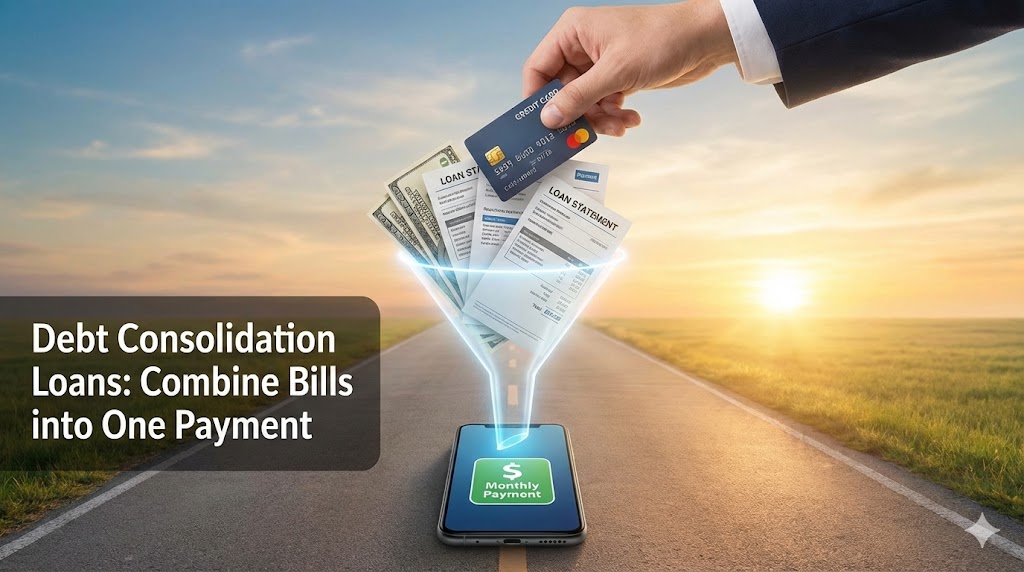
If you are like millions of Americans, your mailbox—and your email inbox—is a source of anxiety. It starts around the middle of the month: the credit card statement from Visa, the store card bill from that department store, the medical bill from last winter, and a high-interest personal loan you took out for an emergency.
Juggling five, six, or seven different due dates is mentally exhausting. Worse, it is financially draining. Minimum payments barely scratch the surface of the principal, and high Annual Percentage Rates (APRs) mean your balance is growing faster than you can pay it off. You feel stuck on a hamster wheel, running hard but going nowhere.
There is a way off the wheel. It is called debt consolidation.
By taking out a debt consolidation loan to combine bills into one payment, you can simplify your life, lower your interest rates, and potentially save thousands of dollars in the long run. This guide is your roadmap to understanding how debt consolidation works, finding the best lenders in the USA, and deciding if this financial strategy is the key to unlocking your debt-free future.
What Is a Debt Consolidation Loan?
At its simplest, a debt consolidation loan is a new loan used to pay off multiple existing debts.
Imagine you have three credit cards totaling $15,000 in debt. Each card has a different interest rate—ranging from 18% to 29%—and a different due date.
- Card A: $5,000 balance @ 24% APR
- Card B: $5,000 balance @ 18% APR
- Card C: $5,000 balance @ 22% APR
You are likely paying three separate minimum payments, and a huge chunk of that money is vanishing into interest charges.
With debt consolidation, you apply for a single personal loan of $15,000. If approved, you use that cash to pay off Card A, Card B, and Card C immediately. Now, those credit card balances are zero. Instead, you have one loan for $15,000. Ideally, this new loan has a much lower interest rate (e.g., 10% to 12%) and a fixed monthly payment.
The Core Benefits
- Simplicity: One bill, one due date, one creditor.
- Lower Interest Rates: Moving from 24% APR to 12% APR saves significant money.
- Fixed Timeline: Credit cards have revolving debt that can last decades. A consolidation loan typically has a fixed term (e.g., 3 or 5 years), giving you a clear “debt-free date.”
How Does Debt Consolidation Work? (Step-by-Step)
Understanding the mechanics of the process removes the fear of the unknown. Here is the typical lifecycle of a debt consolidation strategy.
Step 1: Assessment
You gather all your current debt statements. You tally up the total payoff amount (not just the current balance, but the full payout figure) and calculate your weighted average interest rate. If your average rate is 20%, you need a loan with a rate significantly lower than 20% to make this worthwhile.
Step 2: Prequalification
You shop around with lenders. In the US market, many top online lenders (like SoFi, Marcus, or LightStream) and traditional banks (like Wells Fargo or Citibank) allow you to “prequalify.” This involves a soft credit pull, which does not hurt your credit score, to see what rate you might get.
Step 3: Application and Approval
Once you choose the best offer, you submit a formal application. This will trigger a hard credit inquiry. The lender will verify your income (W-2s, pay stubs) and your debt-to-income (DTI) ratio.
Step 4: Disbursement
Upon approval, there are two ways the money moves:
- Direct Pay: The lender sends the money directly to your creditors (Visa, Mastercard, etc.) to pay off your balances. This is often preferred by lenders as it guarantees the funds are used for debt relief.
- Cash Deposit: The lender deposits the lump sum into your checking account, and you are responsible for paying off the old debts yourself.
Step 5: Repayment
You begin making monthly payments on the new loan. Meanwhile, your credit cards show a $0 balance.
The Math: A Real-World Example of Saving
Let’s look at the numbers. Does combining bills into one payment actually save money, or is it just a shell game?
The Scenario:
You owe $20,000 across four credit cards. The average interest rate is 22%. You are making minimum payments that total roughly $600/month.
- Time to payoff: 15+ years (if only paying minimums).
- Total Interest Paid: Over $18,000.
The Consolidation Solution:
You qualify for a $20,000 personal loan with a 10% APR and a 5-year term.
- New Monthly Payment: Approx. $425/month.
- Time to payoff: Exactly 5 years.
- Total Interest Paid: Approx. $5,500.
The Result:
You save over $12,000 in interest, get out of debt 10 years sooner, and lower your monthly obligation by $175. This frees up cash flow for savings or an emergency fund.
Types of Debt Consolidation Loans
Not all consolidation loans are created equal. Choosing the right vehicle for your debt is crucial for long-term success.
1. Unsecured Personal Loans
This is the most common form of debt consolidation.
- Collateral: None. The loan is backed only by your signature and creditworthiness.
- Risk: Low risk for you (you won’t lose your house if you default), but higher risk for the lender, meaning interest rates depend heavily on your FICO score.
- Best For: Borrowers with Good to Excellent credit (670+ FICO).
2. Secured Personal Loans
- Collateral: Required (e.g., a car, savings account, or other asset).
- Risk: If you fail to pay, the lender can seize your asset.
- Benefit: Because the lender has security, they may offer lower rates or approve borrowers with lower credit scores.
3. Home Equity Loans or HELOCs
If you own a home, you can borrow against your equity.
- Rates: Usually the lowest available, as the loan is secured by real estate.
- The Danger: Your home is on the line. If you run up credit card debt again and can’t pay the HELOC, you face foreclosure. This is trading unsecured debt (credit cards) for secured debt (mortgage), which requires extreme discipline.
4. Balance Transfer Credit Cards
Technically not a “loan,” but a popular consolidation tool.
- Mechanism: You move debt from high-interest cards to a new card with a 0% Introductory APR for 12–21 months.
- The Catch: You must pay off the entire balance before the promo period ends. If you don’t, deferred interest might kick in, or the rate will skyrocket to 25%+.
- Best For: Smaller debt amounts ($5k–$10k) that you can aggressively pay off in a year.
Can I Get a Debt Consolidation Loan with Bad Credit?
This is the most frequent question asked by struggling borrowers. The answer is yes, but with caveats.
If your FICO score is below 620, traditional banks may reject you. However, the online lending market has exploded with specialized lenders targeting “fair” or “bad” credit profiles (e.g., Upstart, Avant, or OneMain Financial).
The Reality of Bad Credit Consolidation:
- Higher Rates: You might not get 10%. You might get 18% or 20%. While this is still better than a 29% penalty APR on a credit card, the savings are slimmer.
- Origination Fees: Subprime lenders often charge an origination fee (1% to 8% of the loan amount), which is deducted from the loan proceeds.
- Co-Signer Options: Adding a co-signer with strong credit can drastically improve your approval odds and interest rate.
If your credit is too damaged for a new loan, you might need to consider Credit Counseling or a Debt Management Plan (DMP) instead of a new loan.
The Hidden Trap: The “Double Debt” Danger
Debt consolidation is a tool, not a cure. The biggest risk isn’t the loan itself—it is human behavior.
Financial experts warn of recidivism in debt. Here is the nightmare scenario:
- You pay off your credit cards with a loan.
- Your credit cards now have a $0 balance.
- You feel “rich” again and fail to close the accounts or cut up the cards.
- You start spending on the cards again.
- Two years later, you have the loan payment plus new credit card payments.
To avoid this, you must fix the spending habits that got you into debt. You must stop using credit cards entirely while paying off the consolidation loan.
Does Debt Consolidation Hurt My Credit Score?
In the short term, yes. In the long term, it usually helps.
The Short-Term Dip:
- Hard Inquiry: Applying for the loan knocks 5–10 points off your score.
- Average Age of Accounts: Opening a new loan lowers the average age of your credit history.
The Long-Term Boost:
- Lower Utilization: Credit utilization accounts for 30% of your FICO score. When you pay off your credit cards, your utilization drops to 0% (revolving debt is weighed differently than installment loan debt). This often causes a significant score jump.
- Payment History: Making on-time payments on the new installment loan builds a positive history.
- Credit Mix: Adding an installment loan to a profile dominated by credit cards improves your “credit mix,” which is 10% of your score.
How to Choose the Best Lender
When you are ready to combine bills into one payment, do not just sign with the first offer you receive in the mail. Treat this like buying a car—shop aggressively.
1. Compare APR, Not Monthly Payment
Salespeople focus on the monthly payment (“Only $200 a month!”). You must focus on the Annual Percentage Rate (APR). The APR includes the interest rate plus any fees. It is the true cost of the loan.
2. Check for Origination Fees
Some “low rate” loans have hidden origination fees. If a lender charges a 5% fee on a $20,000 loan, you lose $1,000 right off the top. You only receive $19,000, but you pay interest on $20,000.
3. Look for “Prepayment Penalties”
You want the freedom to pay off this loan early if you get a bonus or tax refund. Avoid any lender that charges a fee for early repayment.
4. Customer Service Reputation
Read reviews on Trustpilot or the Better Business Bureau. You want a lender with a decent app, easy autopay setup, and responsive support.
Alternatives to Debt Consolidation Loans
If you cannot qualify for a loan, or if the math doesn’t make sense, consider these paths:
1. Debt Snowball / Debt Avalanche Methods
These are DIY repayment strategies.
- Snowball: Pay off the smallest balance first to get a psychological win.
- Avalanche: Pay off the highest interest rate first to save the most money.
2. Debt Settlement
This is a drastic step. You stop paying your bills and hire a company to negotiate with creditors to accept a lump sum (e.g., 50% of what you owe).
- Warning: This destroys your credit score for years and can lead to lawsuits from creditors.
3. Bankruptcy (Chapter 7 or 13)
The legal “reset button.” It clears most debts but stays on your credit report for 7–10 years and should only be used when there is no other way out.
Frequently Asked Questions (FAQ)
Is debt consolidation a good idea?
It is a great idea if you can get a lower interest rate than you are currently paying and if you have the discipline to stop using your credit cards. If you cannot get a lower rate, it generally doesn’t make financial sense.
How much debt do I need to consolidate?
Most lenders have a minimum loan amount, typically between $2,000 and $5,000. Generally, consolidation is most effective for debt loads between $5,000 and $50,000.
Will consolidating my debt lower my total debt amount?
No. A consolidation loan does not reduce the principal amount you owe. It only changes the interest rate and the terms. To reduce the principal, you would need debt settlement (which damages credit).
Can I consolidate bills other than credit cards?
Yes. You can consolidate medical bills, payday loans, store cards, gas cards, and even other personal loans. You typically cannot consolidate student loans into a standard personal loan (student loan refinancing is a separate product).
How long does the process take?
Online lenders are fast. You can often get pre-approved in minutes, approved in 24 hours, and funded within 2 to 5 business days.
Conclusion: Take the First Step Toward Freedom
Debt creates a fog that makes it hard to see the future. It restricts your choices, adds stress to your relationships, and keeps you working for yesterday’s purchases rather than tomorrow’s dreams.
Debt consolidation loans offer a powerful way to clear that fog. By combining your bills into one manageable payment, you regain control. You stop throwing money away on exorbitant interest rates and start making real progress toward a zero balance.
However, the loan is just the vehicle; you are the driver. The success of this strategy depends on your commitment to changing your financial habits.
Ready to see what is possible?
Don’t wait for the next stack of bills to arrive. Check your rate with a reputable online lender today. It usually takes less than two minutes and doesn’t hurt your credit score to look. You might be surprised at how much you can save—and how good it feels to finally see the light at the end of the tunnel.