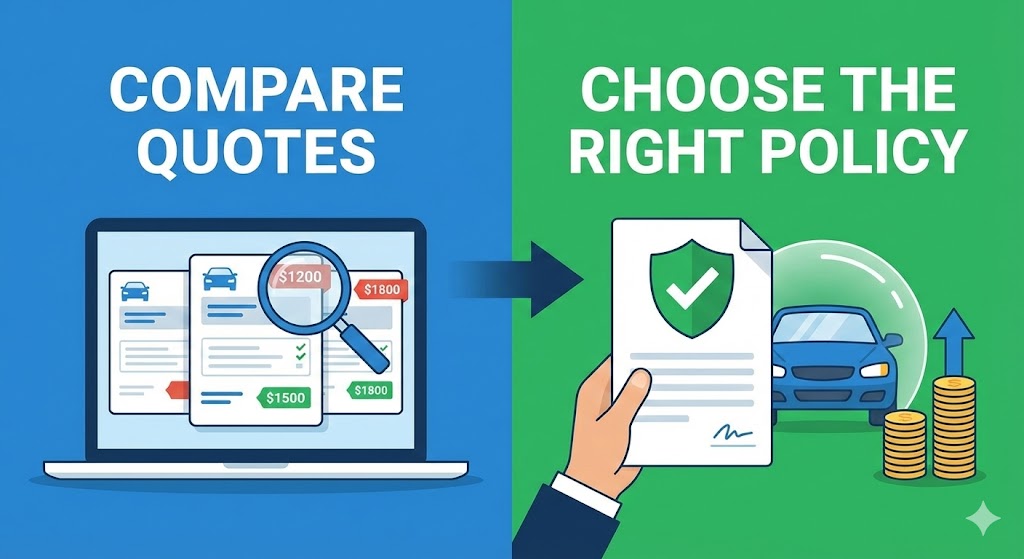
Navigating the world of auto insurance in the United States can feel like driving through a thick fog. With hundreds of providers, confusing terminology, and rates that seem to fluctuate without reason, it is easy to feel overwhelmed. However, settling for the first offer you see or blindly renewing your current policy could be costing you hundreds—even thousands—of dollars every year.
The average cost of car insurance in the U.S. has risen significantly, driven by inflation, increased repair costs, and higher accident rates. But you do not have to be a victim of rising prices. By learning how to effectively compare car insurance quotes and understanding the nuances of policy coverage, you can secure a plan that offers robust protection at a price that fits your budget.
This comprehensive guide will walk you through the steps to compare rates like a pro, decipher the fine print, and choose the right policy for your specific needs.
Why Comparing Quotes is a Financial Necessity
Many American drivers treat auto insurance as a static bill, similar to rent or a mortgage. They pick a company and stay with them for decades. Unfortunately, the insurance industry does not always reward loyalty. In fact, many insurers use data analytics to identify customers who are unlikely to shop around, slowly increasing their rates over time in a practice known as “price optimization.”
The “Underwriting” Variable
Every insurance company uses a unique formula, or “underwriting guidelines,” to determine risk.
- Company A might heavily penalize drivers with a recent speeding ticket.
- Company B might be more lenient with tickets but charge more for drivers with lower credit scores.
- Company C might offer incredible rates for homeowners but high rates for renters.
Because these formulas vary so wildly, the same driver with the same car could receive quotes ranging from $1,200 to $2,500 per year for identical coverage. The only way to find which company views your specific profile favorably is to compare auto insurance rates from multiple carriers.
How to Compare Quotes: A Step-by-Step Guide
Getting an accurate quote requires a bit of preparation. To avoid the frustration of seeing a low advertised price turn into a high final premium, follow this process.
1. Gather Your Personal Information
Before you open a car insurance calculator or comparison site, have the following details ready to go:
- Driver Information: You will need the names, dates of birth, driver’s license numbers, and Social Security numbers for every licensed driver in your household.
- Vehicle Data: The Year, Make, Model, and VIN (Vehicle Identification Number) for all cars. The VIN is crucial for an exact quote as it reveals safety features that can earn you discounts.
- Current Policy: Have your current “Declarations Page” handy. This document lists your current coverages.
2. The “Apples-to-Apples” Rule
This is the most critical rule of comparison shopping. When you look at quotes from Geico, Progressive, State Farm, and others, you must ensure the coverage limits are identical.
- Mistake: Comparing a quote with $25,000 liability limits against a quote with $100,000 limits. The first will obviously be cheaper, but it offers significantly less protection.
- Solution: Set specific parameters (e.g., $100k/$300k liability and a $500 deductible) and request those exact numbers from every provider.
3. Use Aggregators and Direct Sites
Start with an online insurance comparison tool. These platforms allow you to enter your data once and view estimates from multiple carriers. Once you identify the top two or three cheapest options, visit those companies’ websites directly to finalize the quote and check for specific “direct-buy” discounts.
Understanding Policy Coverage: What Do You Actually Need?
A cheap quote is useless if it doesn’t protect you when disaster strikes. Understanding the components of a policy ensures you aren’t paying for fluff, but also aren’t leaving yourself exposed to lawsuits.
Liability Insurance: Protecting Your Assets
This is mandatory in almost every state. It covers the damage you cause to others.
- Bodily Injury Liability: Pays for the medical bills of the other driver and their passengers.
- Property Damage Liability: Pays to fix the other driver’s car or property (like a fence or guardrail).
- Recommendation: Do not stick to state minimums. In a serious accident, medical bills can easily exceed $50,000. If your insurance runs out, you can be sued for the difference, putting your home and savings at risk. Aim for 100/300/100 coverage ($100k per person, $300k per accident, $100k property damage).
Collision and Comprehensive (Full Coverage)
If your car is financed or leased, your lender will require this.
- Collision: Pays to repair your car if you hit another vehicle or object.
- Comprehensive: Pays for damage outside of your control, such as theft, fire, hail, vandalism, or hitting a deer.
- The Deductible Factor: This is what you pay out of pocket before insurance kicks in. A higher deductible (e.g., $1,000 vs. $500) will significantly lower your monthly premium. If you have an emergency fund, raising your deductible is a smart move.
Uninsured/Underinsured Motorist Protection (UM/UIM)
Despite laws requiring insurance, millions of drivers are uninsured. If one of them hits you, or if you are the victim of a hit-and-run, this coverage pays for your medical bills and vehicle repairs. In many states, this is an essential safeguard.
Personal Injury Protection (PIP) and MedPay
These cover medical expenses for you and your passengers regardless of who was at fault. In “No-Fault” states (like Florida or Michigan), PIP is mandatory. In other states, it is optional but highly recommended if you do not have robust health insurance.
Factors That Influence Your Quote
When you apply for instant car insurance quotes, algorithms analyze dozens of risk factors. Knowing what they are can help you improve your standing.
Credit-Based Insurance Score
In most states, there is a strong statistical correlation between credit history and filing claims. Drivers with high credit scores often pay significantly less—sometimes up to 50% less—than drivers with poor credit. Checking your credit report for errors and paying down debt can eventually lead to lower insurance premiums.
Driving Record
A clean record is gold. Accidents and moving violations stay on your record for 3 to 5 years. If you have a spotty record, look for insurers specializing in high-risk auto insurance or SR-22 filings, as standard carriers may deny you or charge exorbitant rates.
Vehicle Safety and Theft Rates
Insurers look at data for your specific car model.
- Cheaper to Insure: Family sedans and SUVs with high safety ratings and low theft rates.
- More Expensive: Sports cars, luxury vehicles with expensive parts, and cars that are statistically frequently stolen.
Mileage and Usage
The more you drive, the higher the risk of an accident. If you work from home or have a short commute, ensure you report your low annual mileage. Many insurers offer a “low-mileage discount” for driving less than 7,500 or 10,000 miles per year.
Proven Tips to Secure the Lowest Premiums
Once you have compared quotes and selected the right coverage, use these strategies to drive the price down further.
1. Bundle Your Policies
The “multi-line discount” is often the largest savings opportunity. Buying your homeowners insurance or renters insurance from the same company that insures your car can save you 10% to 25% on both policies.
2. Take a Defensive Driving Course
Many insurers offer a discount (usually 5% to 10%) if you complete an accredited defensive driving course. This is particularly effective for drivers over age 55 or young drivers looking to offset high base rates.
3. Opt for Telematics (Usage-Based Insurance)
Programs like Progressive’s Snapshot, State Farm’s Drive Safe & Save, or Allstate’s Drivewise use a mobile app to track your driving. They monitor braking, speed, and time of day. If you are a safe driver, you can earn massive discounts based on your actual driving habits rather than general statistics.
4. Ask About “Hidden” Discounts
Don’t assume the online quote applied every discount. When finalizing your policy, ask a representative about:
- Good Student discounts (for high school/college students with a B average).
- Military or Veteran discounts.
- Pay-in-Full discounts (paying 6 months upfront is usually cheaper than monthly).
- Paperless billing and auto-pay discounts.
Red Flags When Choosing a Policy
While hunting for cheap car insurance, be wary of offers that look too good to be true.
- Ghost Brokers: Scammers on social media offering impossibly low rates ($30/month for full coverage). They often pocket your money and give you a fake policy document. Always buy directly from a reputable carrier or licensed agent.
- The “Step-Down” Clause: Some cheap policies reduce your coverage limits to state minimums if a family member (not listed on the policy) drives your car and crashes. Read the fine print carefully.
- Exorbitant Cancellation Fees: Check if the insurer charges a fee if you decide to switch companies mid-term.
Conclusion
Choosing the right car insurance policy is a balancing act between cost and coverage. It requires looking beyond the bold price tag and understanding the protection that lies underneath. By taking the time to compare car insurance quotes from multiple providers, optimizing your deductibles, and leveraging discounts, you can find a policy that safeguards your financial future without draining your bank account.
Don’t wait for your renewal notice to arrive with a price hike. Take control of your automotive expenses today. Gather your documents, run the numbers, and drive with the confidence that you have the best deal on the market.
Frequently Asked Questions (FAQ)
1. How often should I compare car insurance quotes?
It is recommended to shop for new quotes every 6 to 12 months. At a minimum, check rates whenever your policy is up for renewal or if you experience a major life event (moving, getting married, buying a house, or adding a new driver).
2. Does getting a quote hurt my credit score?
No. Insurance companies perform a “soft pull” on your credit report to determine your insurance score. This does not affect your FICO score or credit rating. A “hard pull” only occurs when you apply for credit, like a car loan or mortgage.
3. What is the difference between “At-Fault” and “No-Fault” states?
In “At-Fault” (Tort) states, the driver who caused the accident is responsible for paying damages. In “No-Fault” states, each driver files a claim with their own insurance company for medical expenses (PIP), regardless of who caused the crash. However, property damage is usually still handled on an at-fault basis.
4. Can I switch car insurance companies before my policy ends?
Yes, you can cancel your policy at any time. You do not have to wait for the expiration date. Your current insurer is legally required to refund the unused portion of your premium (prorated refund).
5. Why is my car insurance quote so high?
High rates can result from several factors: a poor driving record, low credit score, living in a high-crime area, driving a luxury vehicle, or being a young/inexperienced driver. Additionally, inflation and rising repair costs have caused rates to increase nationally across the board.
6. Is it cheaper to pay monthly or annually?
It is almost always cheaper to pay your premium in full (either for 6 months or 12 months). Most insurers charge an “installment fee” for monthly payments, which can add up to $50–$100 extra per year.